The Challenge
The client operated in the peptide and research-use-only category, one of the most heavily scrutinized niches on Meta.
Previous growth was limited by recurring ad rejections, unstable advertising infrastructure, limited creative testing capacity, and the risk of losing access to the account during periods of aggressive scaling.
The business already had strong product-market fit. The challenge was building an advertising system capable of supporting significantly higher spend without sacrificing compliance, account stability, or ROAS.
The Goal
Build a stable and compliant paid advertising infrastructure, then scale the account toward aggressive revenue targets.
The priorities were:
- Protecting account stability
- Maintaining strict research-use-only positioning
- Improving tracking and data quality
- Testing creatives at a higher volume
- Scaling winning campaigns without disrupting performance
Phase 1: Foundation and Stability
The first phase focused on building the infrastructure required for long-term scaling.
Tracking and Attribution
Our in-house tracking specialist reviewed the Meta Pixel and Conversions API setup to ensure purchase events were being captured accurately.
Reliable data allowed the performance team to make scaling decisions based on actual campaign and funnel behavior rather than incomplete platform reporting.
Compliance-First Funnel Review
Our compliance team reviewed the advertising journey, including the landing pages, messaging, product positioning, and creative direction.
The funnel maintained strict research-use-only positioning. Direct product or peptide references were avoided in advertising creatives where necessary, while compliant bridge and landing-page approaches were used to reduce rejection risk.
Advertising Infrastructure
The account was supported through Orange Trail’s whitelisted agency ad account infrastructure.
This removed many of the low-spend limitations associated with newly created accounts and provided a more stable foundation for operating in a restricted niche.
Account Health Structure
We used a combination of:
- Engagement campaigns designed to support account health
- Purchase campaigns focused on generating revenue
- A high volume of approved creatives
- Conservative creative messaging during the early stages
The objective was not simply to launch as many purchase ads as possible. It was to maintain a healthy ratio of approved advertising activity while gradually increasing conversion-focused spend.
Phase 2: Creative Testing and Scaling
Once the account had developed sufficient history and performance data, the focus shifted toward expansion.
Because Orange Trail has an in-house team of designers and video editors, creative production was included as part of the service rather than depending on external suppliers.
This allowed us to produce and test up to approximately 25 new advertisements per week when account conditions allowed.
Testing included:
- New visual concepts
- Revised hooks and headlines
- Different customer personas
- Static and video formats
- Alternative offers and positioning
- Safer and more direct-response variations
All creatives were reviewed by the compliance team before launch.
Winning ads were isolated and moved into larger scaling campaigns. Budgets were increased gradually while ROAS, approval rates, and account stability were monitored together.
Why the Orange Trail Model Worked
The account was supported by a complete in-house team:
- Dedicated performance marketing manager
- Compliance specialists
- Designers and video editors
- Tracking and attribution specialist
- Agency advertising infrastructure
- Funnel and landing-page guidance
- Ongoing testing, optimization, and scaling
This meant that tracking problems, creative fatigue, compliance concerns, and campaign performance could be addressed by one coordinated team.
The Results
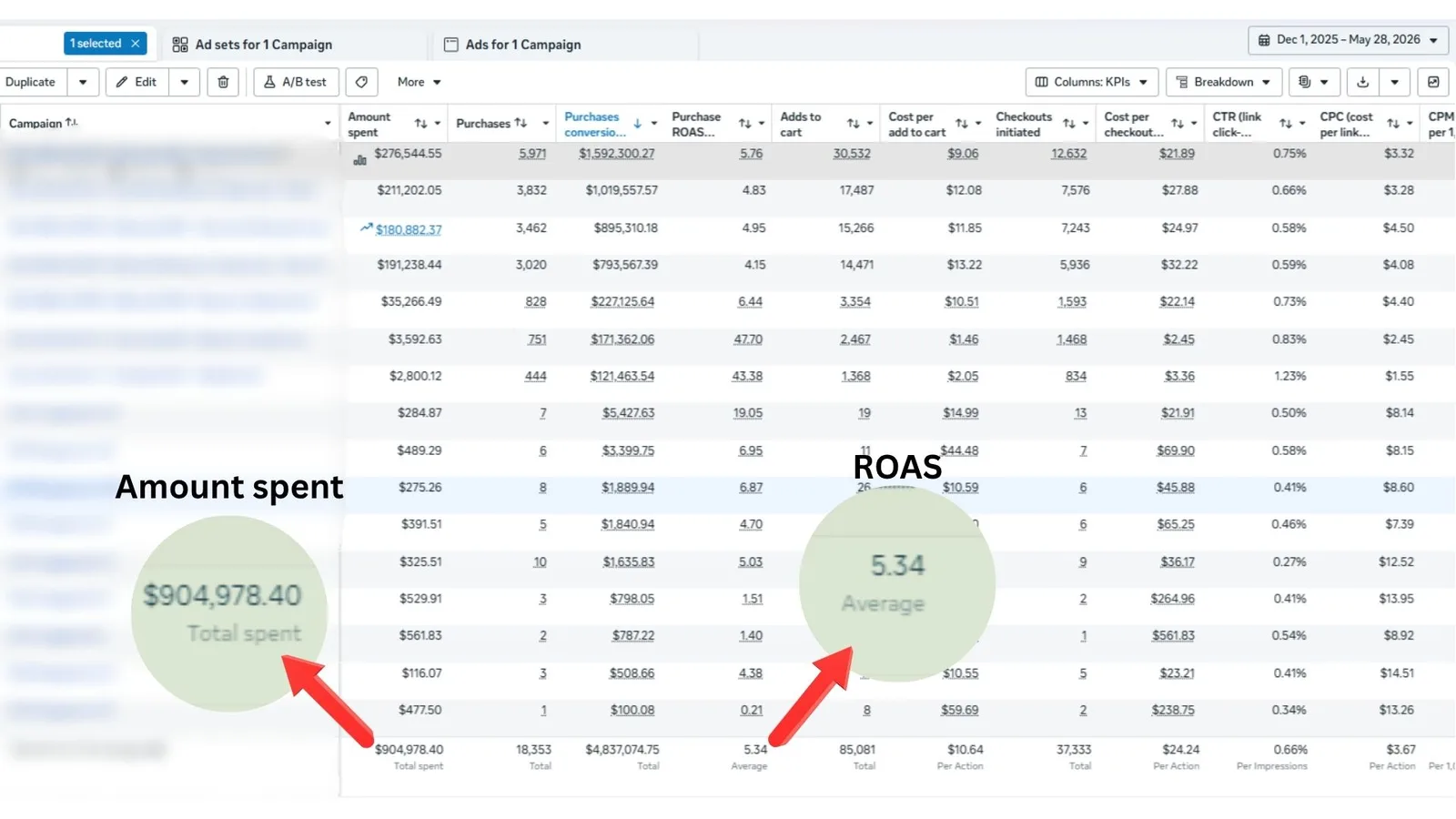
Orange Trail generated $4.84M in tracked revenue from $904,978 in Meta spend, producing a 5.34x ROAS across 18,353 purchases. The account remained active throughout the measured period with zero shutdowns.
The result was not only profitable media buying. It was a stable acquisition infrastructure capable of supporting sustained growth in a category where many advertisers struggle to remain active.