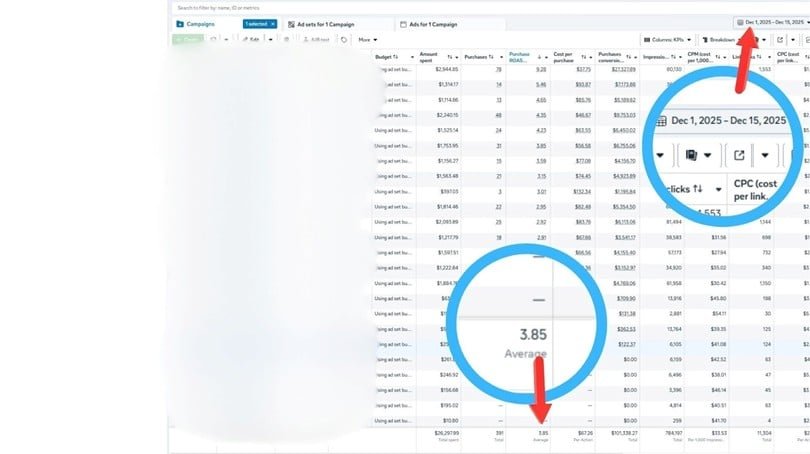
Cable Pro Case Study – Facebook Ads: +131% ROAS Growth in 4 Weeks
Cable Pro
OVERALL RESULTS SO FAR
Profit Increase
- 0 %
Return on Ad Spend in 4 Weeks
- 0 %
About the Client
Cable Pro had given their previous agency a full year to make Facebook Ads work. Twelve months of consistent spend produced flat sales, no clear creative winners, and a growing conviction that the platform could not deliver for their product category. Orange Trail’s AI-driven creative analysis and structured testing process identified high-performing ad styles within two rounds and delivered 131% ROAS growth in four weeks, alongside a 31% increase in profit.
American e-commerce brand specialising in home workout equipment, including cable machine attachments, gym accessories, and fitness hardware. The brand operates direct-to-consumer through its own online store, serving fitness enthusiasts and home gym builders across the United States.
If you have worked with an agency that delivered disappointing results and are starting to question whether Facebook Ads can drive profitable growth for your product, Cable Pro’s story is worth reading. Orange Trail’s performance marketing framework solved that exact problem, as detailed in this case study.
Client Snapshot
Cable Pro had done a lot of things right before engaging Orange Trail. The product was strong, the customer base was loyal, and there was clear product-market fit in the home fitness equipment space. What the brand had not solved was paid acquisition. A full year with a previous agency had produced no meaningful growth.
The account was not failing in an obvious way. Rather, it was treading water with spend going in, unremarkable results coming out, and no clear path to anything better. The founders had started to wonder whether their product category was a poor fit for paid social. It was not. The problem was that nobody had looked at the creative data with the right tools.
Quick Facts
Field | Detail |
Brand | Cable Pro |
Founded | United States |
Industry | Home fitness equipment / ecommerce |
Business Model | DTC (direct-to-consumer) via own online store |
Product Range | Cable machine attachments, gym accessories, fitness hardware |
Primary Acquisition Channel | Facebook/Meta Ads |
Engagement Period | Ongoing (results reported from first 4 weeks) |
The Challenge
When Cable Pro came to Orange Trail, the frustration had been building for a year. The brand had maintained consistent ad spend for twelve months, and the results had been flat. Sales were not growing, and any attempt to increase budget produced a corresponding drop in ROAS, which meant extra revenue was consumed by higher acquisition costs. The team had been patient. They had given the previous agency time, budget, and access, and the account had nothing to show for it beyond a year of data that nobody was using.
The visible problems were clear enough: no systematic creative testing process, no clear winners in the ad account, and a pattern where scaling always led to profitability collapse. But the deeper issue was more specific. The previous agency’s creative approach was disconnected from performance data. Ads were produced based on aesthetic preferences and brand guidelines rather than empirical testing of what drives purchase behaviour. The creatives looked professional and matched the brand identity, but they did not convert.
Cable Pro’s account had accumulated a full year of audience retention data, engagement patterns, and conversion signals. None of it was being used. Nobody had analysed the retention breakdowns on video ads to understand where viewers dropped off, which hooks held attention, or which creative elements correlated with purchases. The result was a library of professional-looking ads that did not convert. They checked every brand guideline box and had high production values, but the performance data told a different story. No amount of audience targeting refinement or bid strategy adjustment could overcome that gap, because the creatives themselves were the bottleneck.
Specific Problems
Twelve months of agency management with no meaningful results. A full year of campaign activity had produced no improvement in sales volume, ROAS, or customer acquisition cost. The account was running, but it was not growing.
Creative assets showed promise but no clear winners. Historical creative performance showed that some ads had delivered decent engagement, but none had produced the combination of click-through rate and conversion rate needed to scale profitably. Signals were buried in the data, but nobody had extracted them.
Sales growth came at the expense of profitability. Every attempt to increase ad spend resulted in a corresponding drop in ROAS. The additional revenue was consumed by higher acquisition costs, so the brand could not grow without losing money.
No systematic creative testing process. New creatives were produced and launched without a structured, hypothesis-driven testing framework. There was no reliable method for identifying which creative styles, hooks, or formats would resonate with the target audience.
Audience retention data was not informing creative decisions. Despite having access to detailed retention breakdowns on video ads, this data was not being analysed or used to guide creative production. A year’s worth of behavioural signals was going to waste.
The Stakes
Without a breakthrough in creative performance, Cable Pro faced a binary choice: continue spending on Facebook Ads at a level that produced marginal returns, or pull back from the channel entirely. Competitors in the home fitness equipment space were investing heavily in paid social, and the brands that figured out creative testing first were going to capture the audience that Cable Pro was losing.
The founders had already invested a year and significant budget without a return on that patience, and the appetite for another extended experiment with unclear outcomes was running out.
Our Approach & Strategy
Full Creatives Analysis and Overhaul
Orange Trail’s approach to the Cable Pro challenge skipped the usual first moves. Rather than adjusting audience targeting or bid strategies (the typical response when an account underperforms), the team focused entirely on rebuilding the creative engine using Orange Trail’s AI-driven creative process combined with deep performance analytics. The goal was to identify high-performing creative styles faster than manual testing could achieve, using the performance marketing methodology the agency applies across all ecommerce accounts.
Phase 1: Historical Creative Performance Analysis (Week 1)
The first action was a comprehensive analysis of every creative asset that had run on the Cable Pro account over the previous twelve months. The team went beyond top-line metrics like click-through rate or cost per purchase and conducted a granular examination of audience retention breakdowns on video assets, engagement patterns by creative format, and conversion rates segmented by creative style and hook type.
Most agencies reviewing an underperforming account would start with audience targeting or bid strategy. Orange Trail started with the creatives, because in ecommerce Facebook Ads, creative quality is the variable that moves the needle most.
The analysis reframed the entire engagement. While no single creative had emerged as a clear winner, certain creative elements showed strong signals at the granular level. Specific product demonstration angles, particular opening hooks, and certain visual compositions consistently outperformed on retention metrics, even when the overall ads they appeared in had not achieved profitable ROAS. The previous agency had the data but they weren’t looking at it at this level.
One finding reshaped the creative direction entirely. Viewers consistently dropped off at the 3 to 4 second mark on videos that opened with branded introductions, but retained through 15 seconds and beyond on videos that opened with product-in-use demonstrations. That single data point changed how creative production was approached from that point forward: every new video would open with the product in action, not a logo or brand name. The retention curves were unambiguous.
**Phase 2: AI-Driven Creative Strategy and Production (Weeks 1 to 2)
**
With the historical analysis complete, the team deployed Orange Trail’s proprietary AI-driven creative process through the agency’s high-ROI creative production service. The process uses performance data patterns to generate creative hypotheses, predict which styles are most likely to resonate, and prioritise production toward the highest-probability winners.
For Cable Pro, the AI analysis identified three primary creative directions to test: product demonstration videos with immediate action hooks, lifestyle-context imagery showing the equipment in home gym setups, and comparison-style content positioning Cable Pro against gym membership costs. The team produced each direction in multiple variants with controlled variables (different hooks, different music, different text overlay positions) to enable statistically meaningful testing.
**Phase 3: Round One Creative Testing (Week 2)
**
The first round of creative testing launched all new assets into a dedicated testing campaign structure with controlled audience parameters and budget allocation. Each variant received sufficient impressions to generate statistically reliable performance data before any scaling decisions were made.
Round one identified two creative styles that outperformed anything previously seen on the account. Both were product demonstration videos with immediate-action hooks and no branded introduction. The performance gap was large enough to confirm the direction and move into a second round focused on refining the winning styles.
**Phase 4: Round Two Testing and Scaling (Weeks 3 to 4)
**
The second round took the winning styles from round one and produced additional variations, testing specific elements within the proven format: different product angles, alternative text overlays, varied call-to-action placements, and adjusted video lengths. Each round of testing narrowed the variables while expanding the number of validated winners.
With multiple high-performing creatives confirmed through two rounds, the team began scaling. Budget increased progressively across the winning assets, and performance was monitored against strict ROAS thresholds. Because the creatives had been validated through structured testing rather than gut instinct, the scaling process held.
ROAS improved as spend increased, which broke the pattern of profitability collapse that had defined every previous attempt. The account had never seen a budget increase hold performance for more than a week. Under the new system, performance improved as spend grew.
**The Week-Two Decision
**
At the start of week two, the team faced a choice. The historical analysis had revealed promising signals in both short-form video (under 15 seconds) and longer product walkthrough content (45 to 60 seconds). Testing both formats simultaneously would produce broader learning but would take longer to reach statistical significance for either. Concentrating on one format would deliver actionable results faster but risked missing a potential winner in the untested format.
The team chose to concentrate on short-form video first, for two reasons: the retention data showed stronger early engagement signals for short-form content, and the production turnaround for short-form variants was faster, which allowed more iterations within the testing window.
Spreading the budget across both formats would have produced inconclusive data for either one within the four-week timeframe the team was working against. Concentrating meant giving up breadth for speed, and in this case speed mattered more. The decision proved right. Every winning creative from rounds one and two was a short-form product demonstration, and the faster iteration cycle is what allowed the team to identify scalable winners within four weeks.
**Tools and Frameworks
**
The engagement used Meta Ads Manager for campaign execution, Orange Trail’s proprietary AI creative analysis system for hypothesis generation and performance prediction, and Meta’s audience retention analytics for granular video performance assessment. Creative production ran through Orange Trail’s creative team, and campaign management operated through the agency’s agency ad accounts infrastructure to ensure account stability during rapid testing and scaling.
Results
Metric | Result |
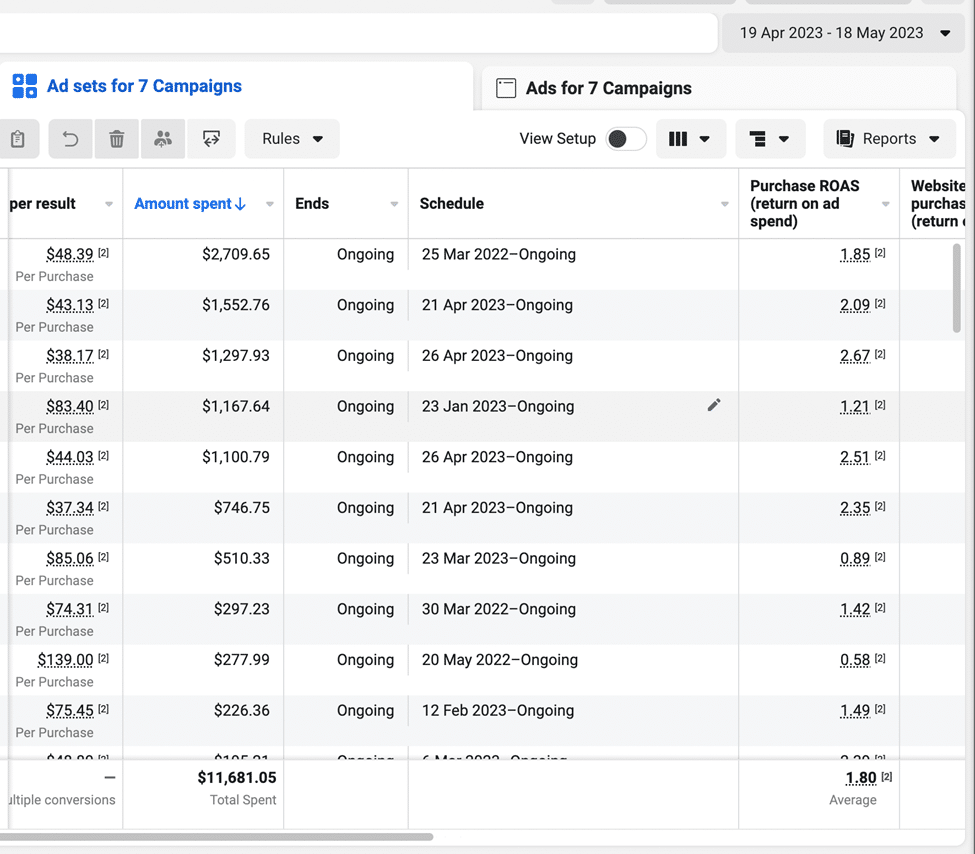
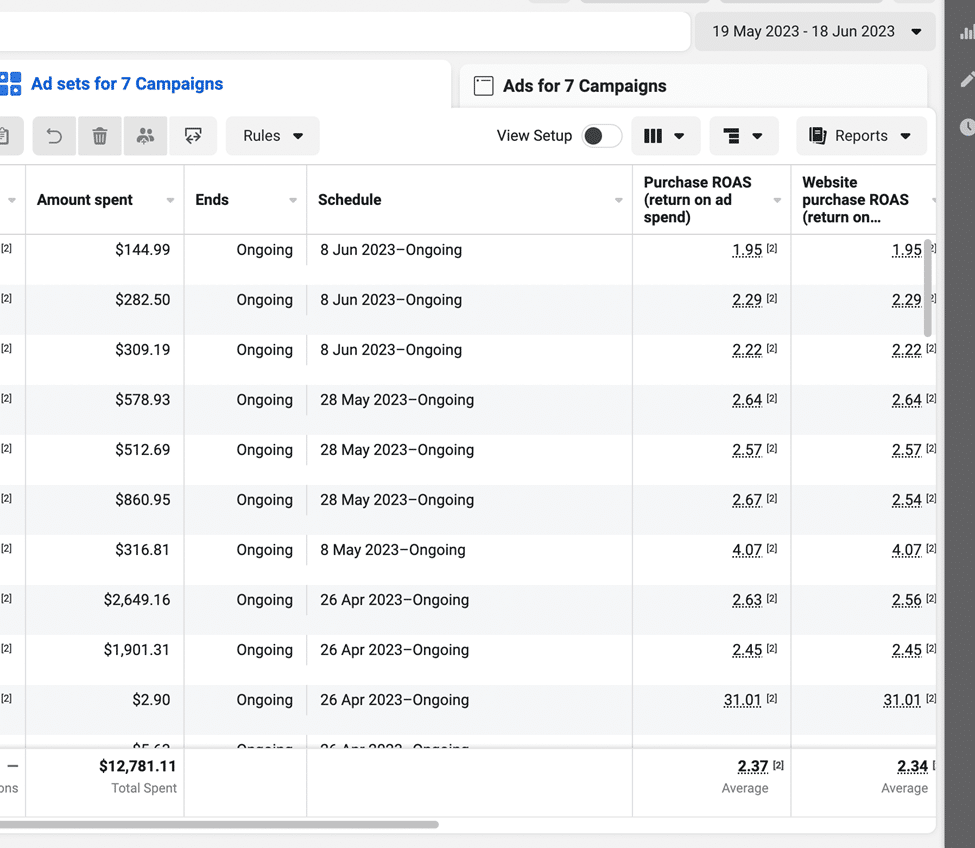
ROAS Growth | +131% increase in return on ad spend in 4 weeks |
Profit Increase | +31% growth in profit |
Ad Spend | Increased total spend while improving efficiency |
Creative Performance | New creatives far surpassed all previous assets on the account |
Testing Velocity | Two rounds of structured testing completed in under 3 weeks |
Results Narrative
The first signal came within the first week of testing. Initial round-one creatives began outperforming the account’s historical benchmarks on cost per click and video retention before any scaling had taken place. That early data confirmed the creative direction identified through the historical analysis and AI-driven process was on target.
The inflection point arrived at the end of week two, when round-one winners were confirmed and round-two testing launched. The combination of validated creative styles and refined variations produced assets that performed at a level the account had never seen. These were not incremental improvements over what the previous agency had produced. They were a step-change in creative effectiveness that unlocked the ability to scale spend profitably for the first time in the account’s history.
By the end of week four, Cable Pro’s results showed a 131% increase in ROAS alongside increased total ad spend. Higher efficiency at higher volume separates an improved acquisition engine from simply cutting budget to inflate efficiency metrics. Profit grew by 31%, directly attributable to improved creative performance and the ability to scale without margin erosion. The brand could now spend more on Facebook Ads and make more money doing it, which had not happened once in the previous twelve months.
Context
The previous agency had managed the account for twelve months without delivering comparable improvement. The 131% ROAS growth came in four weeks, a pace that exceeded the client’s expectations and outperformed typical ecommerce Facebook Ads optimisation timelines by a wide margin. Against industry benchmarks for the home fitness equipment vertical, the post-optimisation ROAS placed Cable Pro well above the median for DTC brands in the category. For a brand that had been questioning whether Facebook Ads could work for their product, the shift was significant.
Honest Caveat
The speed of these results was partly enabled by twelve months of historical data from the previous agency’s campaigns. That data had not been used effectively, but it gave Orange Trail’s AI-driven analysis a rich foundation to work from.
The retention patterns, engagement signals, and conversion data accumulated over a full year allowed the team to move faster than would be possible on an account starting from scratch. Brands with less historical data should expect a longer initial testing phase.
Creative performance at this level also requires ongoing production and testing to maintain, because even the best-performing creatives eventually fatigue. These results are the product of a systematic creative production process, and sustaining them requires that process to keep running.
Are you one of our next success stories?
Book a discovery call
General Industry FAQs
How can a home fitness or gym equipment ecommerce brand use Facebook Ads to scale sales profitably?
Combine data-driven creative testing with a campaign architecture that separates prospecting, retargeting, and retention audiences. For physical product brands, video creatives showing the product in use consistently outperform static imagery. Build a testing pipeline that produces new variants weekly, tests them against controlled variables, and graduates winners to scaling campaigns only after reaching statistical significance. Orange Trail’s performance marketing service builds this system for ecommerce brands.
What Facebook Ads creative strategy works best for ecommerce brands selling physical fitness products?
Short-form product demonstration videos (10 to 20 seconds) with immediate action hooks consistently outperform other formats. Avoid branded introductions at the start of videos, as retention data across multiple accounts shows significant viewer drop-off within the first 3 to 4 seconds when branding leads. Open with the product in action instead. Lifestyle imagery showing the product in a home gym setting also performs well for retargeting audiences. Orange Trail’s creative team produces these assets at scale.
How should an ecommerce brand structure Facebook campaigns to consistently generate profitable sales?
Separate campaigns into three tiers: prospecting (cold audiences, interest-based and lookalike targeting), engagement retargeting (video viewers, page engagers, website visitors), and conversion retargeting (add-to-cart abandoners, checkout initiators). Each tier should have independent budget control and creative sets tailored to the audience’s awareness level. Prospecting runs your best creatives with broad hooks, while retargeting uses social proof, product detail, and urgency messaging.
What type of Facebook ad creatives drive the most purchases for DTC fitness and home equipment brands?
UGC-style product demonstrations, comparison content (product versus gym membership costs, product versus competitors), and before-and-after transformation content consistently drive the highest purchase rates.
For higher-priced items like gym equipment, video content demonstrating build quality, ease of assembly, and range of exercises reduces purchase hesitation. Carousel ads showing multiple product angles also perform well for retargeting audiences who need more information before committing.
How can an ecommerce brand use Facebook retargeting to convert website visitors into buyers?
Segment retargeting audiences by engagement depth and recency. Users who viewed a product page within the last 3 days should see reminder ads featuring the specific product, paired with social proof (review count, star rating, customer photo).
Users who added to cart but did not purchase should see urgency messaging (limited stock, shipping deadline, time-limited discount). Users who visited but did not view a specific product should see broader brand messaging with best-sellers featured. Each segment needs its own creative set and frequency cap.
Which Facebook Ads funnel works best for DTC ecommerce brands selling premium physical products?
Three stages. Awareness/prospecting introduces the product through video demonstrations and lifestyle content to cold audiences. Consideration/engagement retargets users who engaged with stage-one content, providing deeper product information, reviews, and comparison content.
Conversion targets high-intent users (add-to-cart, checkout initiators) with direct purchase messaging, often paired with a small incentive. Allocate approximately 60% to prospecting, 25% to consideration, and 15% to conversion, adjusting based on funnel performance.
How can a small ecommerce brand use Facebook Ads to compete with larger competitors in the fitness equipment space?
Focus on creative quality and testing velocity rather than budget size. Larger competitors often have slower creative production cycles and less agile testing processes. A smaller brand producing four to six new variants per week and systematically identifying winners will outperform a larger brand running the same creatives for months.
Niche targeting (specific workout styles, equipment types, fitness goals) also allows smaller brands to reach relevant audiences at lower CPMs. Orange Trail’s agency ad accounts provide the stability smaller brands need when scaling.
How can Facebook lead ads be optimized for an ecommerce brand to increase form fills without sacrificing quality?
For ecommerce, lead ads work best for specific purposes: waitlist signups for new product launches, quiz funnels recommending products based on preferences, or giveaway entries that build remarketing audiences. To maintain quality, use custom questions rather than auto-filled fields and include a confirmation step requiring active review before submission. That small friction point filters out low-intent submissions without significantly reducing volume.
What is the best Facebook Ads setup to promote premium home gym equipment to serious fitness enthusiasts?
Target audiences built from fitness interest stacks (home gym, cable machine exercises, strength training at home) combined with purchase behaviour signals (online shoppers, engaged shoppers).
Layer with income or home ownership indicators where available. For creative, lead with quality and durability rather than price. Close-up product shots and slow-motion footage of equipment in use work well. Video content showing a full workout routine using the equipment is effective because it answers whether the equipment is versatile enough to justify the investment.
What Facebook Ads KPIs should an ecommerce fitness brand track to prove ROI and justify ad spend?
Track cost per purchase (not just cost per click or cost per add-to-cart), ROAS, and blended CPA across all campaigns. Compare against average order value and customer lifetime value for true profitability. Monitor creative performance metrics (hook rate, hold rate, click-through rate by creative) to identify when assets are fatiguing before the decline shows up in acquisition costs. Use frequency as a leading indicator of audience saturation. Report new customer acquisition cost separately from returning customer metrics.
Cable Pro Specific FAQs
What is the Cable Pro Facebook Ads case study about?
The Cable Pro case study documents how Orange Trail helped an American home fitness equipment ecommerce brand achieve 131% ROAS growth and a 31% profit increase within four weeks through an AI-driven creative overhaul. The brand had spent a full year with a previous agency without meaningful results before engaging Orange Trail’s performance marketing team.
How did Cable Pro use Facebook Ads to generate sales?
Cable Pro used Facebook Ads as their primary paid acquisition channel but could not achieve profitable scale until Orange Trail rebuilt the creative strategy. The work involved a comprehensive historical creative analysis, AI-driven hypothesis generation for new creative directions, two rounds of structured testing, and disciplined scaling of validated winners.
What results did Cable Pro achieve from their Facebook advertising campaign?
Cable Pro achieved a 131% increase in ROAS within four weeks, accompanied by a 31% profit increase. These improvements came while total ad spend increased, meaning the brand grew both efficiency and volume simultaneously, breaking the pattern where scaling had always led to declining returns.
What Facebook Ads strategy did Cable Pro use to grow their business?
The strategy centred on creative performance rather than audience or bid adjustments. It involved analysing twelve months of historical creative data at a granular level (including audience retention breakdowns), using AI-driven analysis to identify high-probability creative directions, and running two rounds of structured testing to validate and refine winners before scaling.
How did Cable Pro target the right audience on Facebook for their products?
Fitness interest stacks (home gym, cable exercises, strength training), purchase behaviour signals, and lookalike audiences built from existing purchasers. But the primary lesson from this case study is that audience targeting was not the bottleneck. The creative overhaul had a far greater impact on performance than any targeting change.
What type of ad formats did Cable Pro use in their Facebook campaigns?
Short-form product demonstration videos with immediate action hooks and no branded introduction. These outperformed all other formats tested, including static imagery, carousel ads, and longer-form product walkthroughs. Opening with the product in action rather than brand messaging improved viewer retention and the conversion rates that followed.
How much did Cable Pro invest in Facebook Ads and what was their return?
Specific budget figures have not been disclosed. Total ad spend increased during the engagement, and this higher spend was accompanied by 131% ROAS growth and 31% profit increase. The brand spent more and made more per dollar spent at the same time.
How did Cable Pro optimize their Facebook Ads for better profitability?
The optimisation focused on creative performance. Historical audience retention data identified which visual elements and hooks drove engagement, AI-driven analysis generated hypotheses that were tested across two rounds, winning creatives were scaled with strict ROAS thresholds, and underperforming assets were cut quickly. This data-driven creative process, rather than bid or audience adjustments, drove the performance transformation.
Can other ecommerce brands replicate Cable Pro's Facebook Ads strategy?
Yes, the methodology is not product-specific. Any ecommerce brand with historical Facebook Ads data can benefit from systematic creative analysis, AI-driven hypothesis generation, and structured testing. The requirements are a willingness to invest in creative production and testing, patience to complete at least two testing rounds before scaling, and the discipline to scale only validated winners.
What key takeaways can marketers learn from the Cable Pro Facebook Ads case study?
Creative performance is the single largest lever for ecommerce Facebook Ads and should be addressed before audience or bid optimisation. Historical data from unsuccessful campaigns contains valuable signals when properly analysed. AI-driven creative analysis reduces the number of testing rounds needed to find winners. And short-form product demonstration videos with immediate hooks consistently outperform branded or editorial content for DTC physical product brands. Brands looking to apply these principles can explore Orange Trail’s performance marketing and creative production services.
Ready to fix your Facebook Ads creative strategy? Let's talk this week.
No long-term contracts. No fluff calls. In 30 minutes, Orange Trail will audit your current creative performance, identify your biggest growth lever, and give you a concrete next step, whether you work with them or not. The same performance marketing team that delivered 131% ROAS growth for Cable Pro is ready to look at your account. Book a 30-Minute Audit Call with us today!