Cost of Facebook Ads in 2026: Agency Fees, Benchmarks & What You Actually Pay
Facebook Ads Pricing: Agency Fees vs In-House Costs in 2026
- April 4, 2026
Table of Contents
You checked your Ads Manager this morning, and the numbers do not add up: the spend is climbing, but conversions are not keeping pace. Before you cut the budget or blame the platform, it helps to understand what you are actually paying for and why.
The cost of Facebook ads in 2026 is not just a CPC figure; it is the sum of your ad spend, your management setup, your creative production, and how efficiently all three work together.
This guide breaks each of those down so you can make a clear-headed decision about where your money is going and what to do about it.
How Much Do Facebook Ads Cost in 2026?
The cost of Facebook ads varies more than most benchmarks suggest because platform costs respond to competition, creative quality, audience behavior, and seasonality simultaneously. That said, there are reliable ranges that apply to most accounts.
Average Cost Benchmarks
| Metric | Typical Range | What Drives Variance |
| CPC (cost per click) | $0.50–$3.00 | Industry, creative quality, placement |
| CPM (cost per 1,000 impressions) | $8–$25 | Audience size, competition, time of year |
| CPA (cost per purchase or lead) | $5–$50+ | Funnel quality, offer, landing page |
| CTR (click-through rate) | 0.9%–2.5% | Creative relevance, audience match |
These are starting points, not guarantees. An ecommerce brand with a strong creative and a well-optimized landing page can sit well below the CPA floor. A brand with weak assets and a slow checkout can blow past the ceiling.
What Truly Moves the Cost of Facebook Ads
Understanding why costs shift gives you more control over them:
- Industry competition: Retail, finance, and insurance categories see higher CPMs because more advertisers are bidding for the same inventory. Niche categories with less competition often enjoy lower entry costs.
- Audience size and quality: Narrow audiences exhaust quickly and drive up CPMs. Overly broad audiences dilute relevance. The sweet spot is a well-defined core audience with room for the algorithm to optimize.
- Ad creative performance: This is the most controllable cost lever you have. A higher CTR signals relevance to Meta’s algorithm, which rewards you with cheaper delivery. Poor creative does the opposite—your CPM rises as the platform deprioritizes low-engagement ads.
- Seasonality: Q4 is consistently the most expensive period to advertise on Meta. CPMs can rise 30–60% between October and December as retail advertisers flood the auction. Plan your budgets accordingly, especially if you rely on Black Friday and holiday traffic.
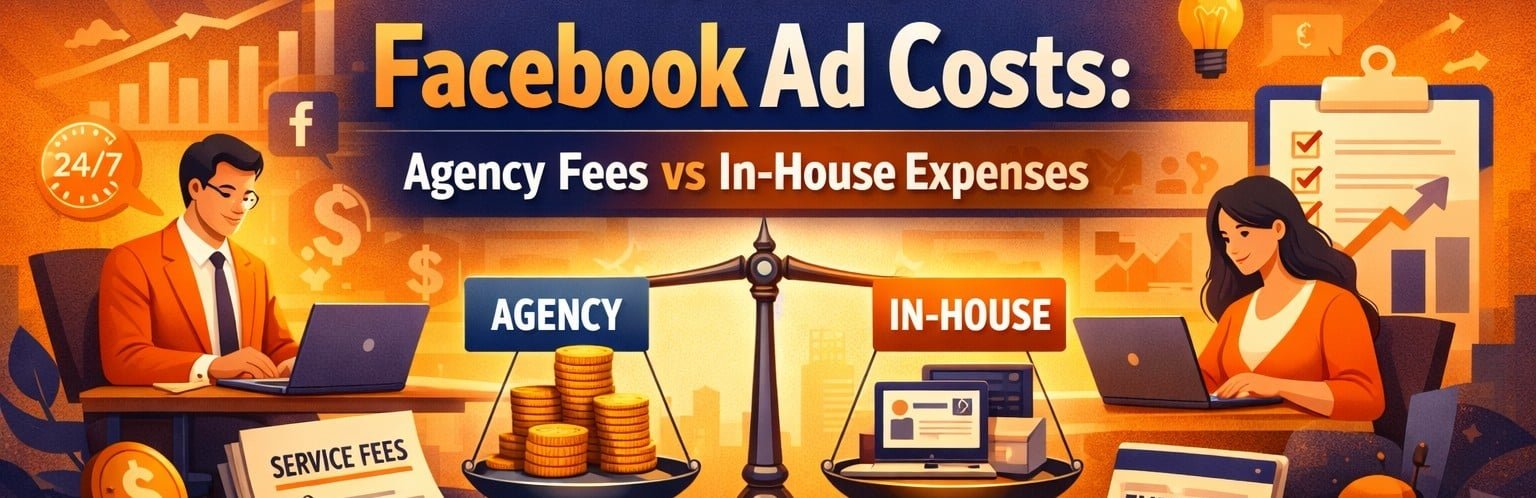
Agency Fees vs. In-House Costs: What Is the Real Difference?
When people ask about the cost of Facebook ads, they often focus on ad spend and overlook the management layer. That gap in thinking leads to poor decisions, either by underestimating what in-house management genuinely costs or by dismissing agencies as too expensive without comparing like-for-like.
Agency Pricing Models
| Model | Typical Cost | Best Suited For |
| Flat monthly retainer | $1,500–$5,000/month | Brands with stable, predictable spend |
| Percentage of ad spend | 10–20% of monthly spend | Scaling brands with growing budgets |
| Hybrid (base fee + %) | Varies by scope | Brands in active growth phases |
A flat retainer gives you cost certainty. A percentage model means the agency’s fee scales with your spend, which can work well when performance is strong, but creates an implicit incentive to grow budgets regardless of efficiency. The hybrid model attempts to balance both.
In-House Costs: What People Forget to Count
Running ads in-house looks cheaper on paper until you account for the full picture:
- Salary: A competent media buyer costs $3,000–$8,000 per month depending on market and experience. A senior performance marketer at the top of that range often still lacks the creative and tracking depth an agency team carries collectively.
- Tools: Analytics platforms, creative tools, tracking infrastructure, and reporting software add $300–$1,000 per month in tooling costs that are easy to overlook.
- Testing budget losses: In-house teams learning on the job burn real budget. The inefficiency during the learning curve is a direct cost, even if it does not appear on a management invoice.
- Creative production: If your media buyer is not also a creative strategist (and most are not) you will need a separate resource for ad production. That cost sits on top of the salary.
The Hidden Cost Reality
Agencies often appear more expensive upfront. In practice, an experienced Facebook ads agency frequently reduces three categories of waste that in-house teams generate more of:
- Wasted ad spend on underperforming creatives and audiences that a seasoned team would retire faster.
- Testing inefficiency from running underpowered tests or drawing conclusions too early.
- Time to scale—an agency that has navigated this process across dozens of accounts moves faster than a team doing it for the first time.
The question is not “is the agency fee expensive?” It is “what does it cost me to run this less well?”
For a fuller picture of what agency management covers, see our Facebook agency ad accounts overview.
What Is the Average CPC for Facebook Ads?
CPC is one of the most-cited metrics in paid social, and one of the most misread. A low CPC is only good if the clicks convert. A high CPC can be entirely justified if the audience is qualified and the landing page does its job.
CPC by Funnel Stage
The cost of Facebook ads per click rises as you move down the funnel, because you are reaching smaller, higher-intent audiences:
| Funnel Stage | Typical CPC Range | Campaign Goal |
| Top of funnel (TOF) | $0.50–$1.50 | Awareness, reach, video views |
| Middle of funnel (MOF) | $1.00–$2.00 | Retargeting, engagement, consideration |
| Bottom of funnel (BOF) | $1.50–$3.00+ | Conversions, purchases, leads |
Do not optimize purely for lowest CPC. A $0.60 click from a cold audience that never buys costs more than a $2.50 click from a cart abandoner who converts.
CPC by Industry
- Ecommerce: Moderate CPC ($0.70–$2.00), but margins and AOV determine whether those clicks are profitable. Higher-ticket products absorb higher CPCs more comfortably.
- Local services: Higher CPC ($1.50–$3.00+), often offset by strong lead value. A single converted customer can justify weeks of ad spend.
- B2B: Highest CPC category, sometimes exceeding $3.00–$5.00, with a long sales cycle. Attribution is more complex and the funnel typically requires more nurturing touchpoints.
If your CPC is running significantly above these ranges, the cause is usually one of three things: creative fatigue, audience exhaustion, or a targeting structure that is working against the algorithm rather than with it.
Why Are Your Facebook Ads Expensive?
High costs are rarely random. They are usually the output of identifiable problems in your account structure, creative, or tracking setup.
Common Causes of High Ad Costs
Weak creatives
Low engagement rates tell Meta’s algorithm that your ad is not relevant. The platform responds by showing it less and charging more for delivery. A creative that generates a 0.5% CTR will consistently cost more per click than one generating 1.5%, even against the same audience.
Poor audience targeting
Audiences that are too narrow exhaust quickly and drive CPMs up. Audiences that are too broad dilute the signal and produce low-quality clicks. The goal is a defined core audience that gives the algorithm enough room to find your best buyers.
Ad fatigue
When the same creative runs against the same audience for too long, frequency rises and performance drops. Engagement falls, CPMs rise, and you end up paying more for worse results. Most accounts need fresh creative entering rotation every two to four weeks.
Broken or incomplete tracking
If your pixel is missing events or your Conversions API is not set up, Meta’s algorithm is optimizing on partial data. It cannot find more of your best customers if it does not have a clear signal of who your best customers are. This is one of the most common (and most fixable) causes of rising costs. For more on how tracking issues compound account problems, see our guide on Facebook ad account errors and how to fix them.
Poor landing page experience
The cost of Facebook ads does not end at the click. If your landing page is slow, confusing, or misaligned with the ad’s promise, your conversion rate suffers and your effective CPA climbs—even if your CPC looks fine.
How Meta’s Algorithm Sees Your Account
Meta rewards accounts that demonstrate consistent, reliable performance signals:
- High engagement rates on creative
- Strong conversion signals from pixel and CAPI data
- Consistent spending patterns without erratic pausing and restarting
Accounts that feed the algorithm clean, consistent data tend to see lower delivery costs over time. Accounts that starve it of signal (through poor tracking, frequent campaign restarts, or inconsistent spend) pay a premium for that instability.
How to Reduce the Cost of Facebook Ads Without Hurting Performance
Cutting costs the wrong way (pausing campaigns, slashing budgets abruptly, narrowing audiences) usually makes things worse. These are the approaches that actually work.
Creative Optimization
Creative is the fastest lever for reducing the cost of Facebook ads because it directly affects your CTR, which directly affects your delivery costs.
- Test multiple hooks every week. The first two seconds of a video or the first line of an ad determines whether someone stops scrolling. Test different opening angles against the same offer.
- Prioritize UGC and native-style content. Ads that look like organic content consistently outperform polished brand ads in terms of engagement and cost efficiency.
- Iterate fast and retire losers early. Do not wait for a creative to fail dramatically. Set a clear performance threshold and replace underperformers before they drag your account metrics down.
Media Buying Improvements
- Use broad targeting. Give Meta’s algorithm room to find your buyers. Stacking interest layers often restricts delivery and raises costs without meaningfully improving quality.
- Consolidate ad sets. Too many ad sets with small budgets means none of them exits the learning phase properly. Fewer, better-funded ad sets generally outperform a fragmented structure.
- Scale winning creatives, not audiences. When a creative is performing well, increase budget on the campaign rather than duplicating into new audience segments.
Technical Fixes That Reduce Wasted Spend
| Fix | What It Addresses | Expected Impact |
| Implement Conversions API (CAPI) | Recovers lost purchase signal from iOS restrictions | Improves optimization, reduces CPA over time |
| Improve page load speed | Reduces post-click drop-off | Directly improves conversion rate |
| Optimize checkout flow | Removes friction between click and purchase | Lowers effective CPA without touching ad spend |
| Audit pixel event firing | Ensures all key actions are tracked | Gives algorithm accurate data to optimize |
For accounts already spending meaningfully, these technical fixes often produce faster cost improvements than any creative or targeting change. If you are working with an Orange Trail agency ad account, our team audits tracking setup as part of onboarding—because optimization built on incomplete data rarely holds.
What Budget Do You Need for Facebook Ads?
Budget requirements depend on your target CPA, your conversion rate, and how quickly you need the algorithm to gather usable data.
Starting Budgets by Phase
| Phase | Recommended Monthly Budget | Goal |
| Testing | $1,000–$3,000/month | Validate creative, audience, offer |
| Early scaling | $5,000–$15,000/month | Identify winning combinations |
| Scaling | $15,000–$50,000+/month | Grow volume while maintaining efficiency |
Do not interpret these as guarantees of performance at each level. They are the minimum budgets needed to generate enough data to make meaningful decisions at each stage.
Budget Planning Formula
A straightforward way to set your initial budget:
Target CPA × Desired conversions per month = Required ad spend
For example:
- Target CPA: $25
- Goal: 200 sales per month
- Required budget: $5,000/month
This assumes your CPA target is realistic for your category and your conversion rate is already known. If you are entering a new market or testing a new product, add a 30–50% buffer for the learning phase, where costs run higher before the algorithm stabilizes.
The formula also assumes your landing page and offer are already converting at a reasonable rate. Running paid traffic to an unoptimized funnel inflates your real CPA and makes your budget go much further than the numbers suggest it should.
Is Facebook Advertising Worth the Cost?
For most ecommerce and DTC brands, yes—but the answer depends more on your business fundamentals than on the platform itself.
When Facebook Ads Work Well
- Strong product-market fit. Ads accelerate demand that already exists. If people want your product and your offer is clear, paid traffic compounds that interest efficiently.
- Healthy margins. A product with 50–60% gross margin can absorb a $30 CPA and remain profitable. A 20% margin product at the same CPA cannot. Know your numbers before you scale.
- High-quality creative. Brands that invest in creative production consistently see lower CPAs and higher ROAS than those running static, generic assets.
When Facebook Ads Struggle
- Low margins or low AOV. If your average order value is under $40 and your margins are thin, the cost of Facebook ads per acquisition will frequently exceed what the customer is worth.
- Poor creative. This comes up repeatedly because it matters that much. No amount of targeting sophistication compensates for an ad that does not earn attention.
- Weak landing pages. If the post-click experience does not match the ad’s promise or loads slowly, you are paying for traffic that has little chance of converting.
For a direct comparison of how Meta and Google paid channels perform across different business types, see our breakdown of Facebook Ads vs. Google Ads.
How Bidding Affects the Cost of Facebook Ads
Bidding strategy controls how aggressively Meta competes in the auction on your behalf. The wrong setting for your account’s stage can either starve your campaigns of delivery or overpay for conversions.
Bidding Options and When to Use Them
| Bidding Type | How It Works | Best Used When |
| Lowest cost (default) | Meta spends your budget at the lowest available CPA | Starting out, or when volume matters more than CPA control |
| Cost cap | Sets a target average CPA; Meta adjusts bids to stay near it | You have a clear CPA ceiling and enough data to set it accurately |
| Bid cap | Sets a hard maximum bid per auction | High-volume accounts with strong performance data |
Lowest cost bidding is the right default for most accounts, particularly during the learning phase. Applying cost caps or bid caps too early (before the algorithm has enough conversion data) often results in restricted delivery, higher CPMs, and a campaign that never properly exits the learning phase.
The algorithm needs data to optimize. Bidding strategies that restrict it too tightly before that data exists tend to make the cost of Facebook ads higher, not lower.
If your campaigns are stalling in the learning phase or your costs are climbing without an obvious creative or targeting cause, bidding structure is worth auditing. Reach out via WhatsApp and we can take a look at your account setup.
What Drives the Real Cost of Facebook Ads: Putting It Together
The cost of Facebook ads in 2026 is not a single number. It is the product of your creative quality, your tracking infrastructure, your audience strategy, your bidding setup, and the efficiency of your post-click experience. Any one of those variables can inflate costs significantly if it is underperforming.
Agencies look expensive when you compare the fee to zero management cost. They look different when you compare them to the cumulative cost of inefficient spend, slow testing, and delayed scaling. The right question is not whether you can afford an agency—it is whether you can afford to run this without one.
If you want a straight read on where your current campaigns are leaking spend and what it would take to fix it, contact us on Telegram or via Messenger. No pitch, just an honest audit.
Frequently Asked Questions
How much do Facebook ads cost in 2026?
Costs range from $0.50 to $3.00 per click and $5 to $50+ per conversion, depending on your industry, creative quality, and funnel setup. CPM typically sits between $8 and $25. These figures shift with competition and seasonality, particularly in Q4. Use them as orientation points, not fixed targets.
What is the average CPC for Facebook ads?
Most accounts see CPC between $0.50 and $3.00, with the lower end common in broader awareness campaigns and the higher end in competitive conversion-focused campaigns. Industry matters significantly—B2B accounts routinely exceed $3.00 per click. Track CPC alongside conversion rate, not in isolation.
Why are my Facebook ads expensive?
The most common causes are weak creative (low CTR signals low relevance to Meta), poor tracking setup, ad fatigue from overexposed creatives, and audiences that are either too narrow or poorly defined. Audit your creative performance and pixel event firing before adjusting budgets.
How can I reduce the cost of Facebook ads?
Start with creative—test new hooks, introduce UGC, and retire underperformers early. Then check your tracking: implement CAPI if you have not already. Finally, simplify your ad set structure and give the algorithm more room to optimize. Avoid cutting budgets abruptly, as this disrupts the learning phase and often raises costs.
What budget do I need for Facebook ads?
Most businesses need $1,000–$3,000 per month to run a meaningful test. Use your target CPA multiplied by your desired monthly conversions to set a realistic spend figure. Build in a buffer for the learning phase, where costs run higher before stabilizing.
Is Facebook advertising worth the cost?
For brands with strong margins, clear product-market fit, and quality creative, yes. For low-margin products or brands with unoptimized funnels, the cost of Facebook ads per acquisition can quickly exceed customer value. Model your unit economics before scaling spend.
How does bidding affect ad pricing?
Bidding controls how Meta competes in the auction on your behalf. Stricter caps reduce spend but can limit delivery and raise CPMs if applied before you have enough conversion data. Default to lowest cost bidding early, then introduce caps once your account has sufficient learning data.
Share this post with: