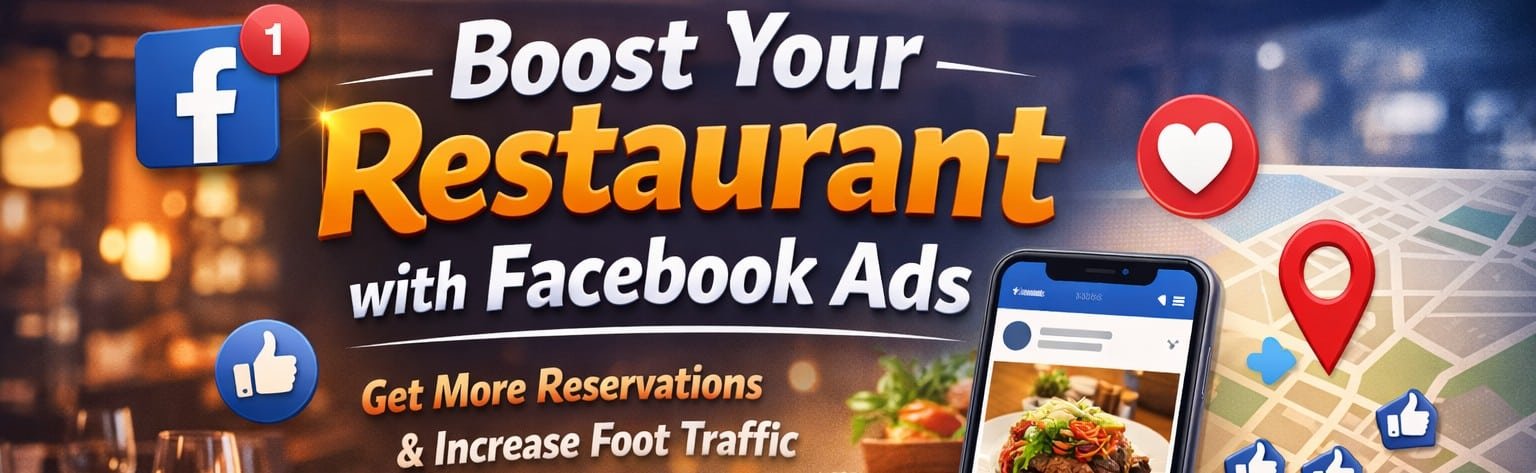
Facebook Ads for Restaurants: Drive Bookings and Foot Traffic in 2026
- April 9, 2026
Table of Contents
Tables are sitting empty on a Tuesday night, your weekend reservations are softer than they should be, and the Instagram posts are not doing the heavy lifting anymore.
Facebook ads for restaurants are one of the most practical ways to change that picture, because the platform is built around exactly the kind of decision your customers are making: where to eat tonight, what to order, whether to book a table or just walk in.
What works, how much it costs, and how to make a campaign that gets people to sit down are all covered in this guide.
Do Facebook Ads Work for Restaurants?
They do, consistently, when the targeting is local and the creative gives people a genuine reason to act. Restaurants are in some ways an ideal fit for Facebook advertising because the decision cycle is short, the visual format suits the platform, and geography does a significant portion of the targeting work for you.
Why Facebook Works for Restaurants
Hyper-local targeting is precise and affordable. You can reach people within one to five kilometres of your restaurant, which means your budget is spent on people who can realistically walk through your door tonight. That level of geographic precision is difficult to match on most other paid channels.
Food is inherently visual. A well-shot plate, a busy dining room at golden hour, or a 30-second video of your kitchen in motion earns attention in a way that most products cannot. The creative does not need to be elaborate. It needs to look like food someone wants to eat.
Restaurant decisions are often impulsive. Unlike a dental procedure or a software subscription, choosing a restaurant is a low-stakes decision made quickly. A well-timed ad with a compelling offer can move someone from “I haven’t thought about dinner yet” to “I’ll book a table now” within a single scroll session.
Retargeting compounds results over time. People who have visited your website, engaged with your Facebook page, or watched a previous video ad are significantly more likely to convert than cold audiences. Building those retargeting pools early means your campaigns get more efficient as they mature.
Best Use Cases for Facebook Ads for Restaurants
- Table reservations: Particularly effective for weekend bookings, special menus, or occasions (Valentine’s Day, anniversaries, Mother’s Day).
- Takeout and delivery promotion: Offer-driven campaigns targeting people nearby during lunch and dinner hours.
- Event promotion: Live music nights, themed dinners, tasting menus, and seasonal events respond well to Facebook’s event-style ad formats.
- New restaurant openings: Building local awareness quickly in the weeks before and after launch.
- Quiet period recovery: Filling gaps on slower nights (Monday to Wednesday) with targeted promotions aimed at the local area.
How Much Should a Restaurant Spend on Facebook Ads?
Facebook ads for restaurants do not require large budgets to produce results, which is one of their main practical advantages for independent and small-chain operators. The right budget depends on your size, your goals, and how aggressively you want to fill your tables.
Typical Monthly Budgets by Stage
| Restaurant Type | Recommended Monthly Budget | Primary Goal |
| Small or single-location | $300–$1,000/month | Local awareness and bookings |
| Growing or multi-site | $1,000–$3,000/month | Consistent reservation flow |
| Multi-location or chain | $3,000+/month | Scaled local campaigns per site |
Even at the lower end of these ranges, a well-structured campaign with a strong offer can generate a meaningful volume of reservations. A $500/month campaign targeting a tight local radius with a compelling offer will consistently outperform a $2,000/month campaign with generic creative and no clear call to action.
Expected Cost Benchmarks
| Metric | Typical Range | Notes |
| CPC (cost per click) | $0.30–$1.50 | Lower than most industries due to visual engagement |
| Cost per lead or reservation | $5–$20 | Varies by offer strength and landing page quality |
| Cost per walk-in (estimated) | Difficult to track directly | Use promo codes or booking source tracking |
| CPM (cost per 1,000 impressions) | $5–$15 | Local targeting keeps this relatively low |
The cost per reservation can be reduced significantly by improving two variables: the quality of the offer and the simplicity of the booking process. Every extra click or form field between someone seeing your ad and completing a reservation reduces your conversion rate and raises your effective cost per booking.
What Type of Ads Bring More Customers to Restaurants?
The creative is what determines whether someone scrolls past your ad or stops to look. For restaurants, the bar for stopping someone is both lower (food is compelling) and higher (everyone else is also posting food) than in most categories.
High-Performing Ad Formats
Short-form video (15 to 30 seconds)
Video of food being plated, a busy dining room, or your chef at work outperforms static images in most restaurant ad accounts. It communicates atmosphere and quality in a way a single photo cannot. Reels-format vertical video performs particularly well in 2026 across both Facebook and Instagram placements. You do not need professional production. A steady phone shot with good lighting and sound will outperform a generic stock video every time.
Carousel menus
Multiple cards showing different dishes, with a brief description and price where appropriate, work well for takeout and delivery campaigns. They let people browse before committing, which suits the consideration stage well.
User-generated content (UGC)
Real guests sharing their experience, whether a table photo, a video review, or a tagged post, carries more credibility than branded content. Repurpose it with permission. Social proof in ad creative significantly reduces the skepticism a cold audience brings to a brand’s own claims.
“Today’s special” or time-sensitive posts
Ads that feel current and time-specific (“tonight only,” “this weekend”) create a different kind of attention than evergreen brand content. They suggest something is happening now, which suits the impulsive nature of restaurant decisions.
Creative Angles That Work
| Creative Angle | Best Format | Campaign Goal |
| Atmosphere and ambiance | Short video or photo | Awareness and brand appeal |
| Specific dish hero shot | Static image or carousel | Menu promotion, delivery |
| Limited-time offer | Static with clear text overlay | Reservations, footfall |
| Guest review or testimonial | UGC video or screenshot | Trust-building, retargeting |
| Event or occasion | Graphic with date and details | Event bookings |
How to Promote Your Restaurant Locally on Facebook
Local promotion is where Facebook ads for restaurants are most effective, and the setup is more straightforward than many restaurant owners expect.
Core Targeting Setup
Radius targeting
For urban restaurants, a 1 to 3 kilometre radius is typically sufficient and keeps your CPM low by focusing on people who are genuinely nearby. Suburban or destination restaurants may extend to 5 to 10 kilometres, particularly for weekend reservations where people are willing to travel further.
Mobile-first campaigns
The majority of restaurant ad impressions are served on mobile. Design your creative in vertical format (9:16 for Reels, 4:5 for feed), keep text minimal, and ensure your landing page or booking flow works cleanly on a phone screen.
Time-based scheduling
Meta allows you to schedule ads to run during specific hours. For a lunch promotion, run ads from 10am to 1pm. For dinner reservations, target the early-to-mid afternoon window when people are thinking about where to eat that evening. Running ads at 2am for a dinner promotion is wasted spend. Align delivery with the decision window.
Advanced Targeting Worth Adding
Retargeting page visitors and past engagers
People who visited your website in the last 30 to 60 days, watched your previous video ads, or engaged with your Facebook or Instagram page are warm prospects. A specific offer served to this audience (return this week and get a complimentary dessert) consistently outperforms the same offer served cold.
Custom audiences from past customers
If you collect email addresses through your booking system or loyalty program, upload that list to Meta and run campaigns specifically to people who have already visited. Re-engagement campaigns targeting past diners are among the highest-ROI activities available to restaurant advertisers.
Seasonal and event-based campaigns
Plan your campaign calendar around key dates: Valentine’s Day, Mother’s Day, Christmas party season, local events or festivals. These campaigns benefit from being set up two to three weeks in advance, so the algorithm has time to optimize before the peak date arrives.
For more on how retargeting works within a broader paid social program, see our performance marketing overview.
What Offers Work Best for Restaurant Ads?
The offer is the hinge point of most restaurant ad campaigns. A strong creative with a weak offer underperforms. A straightforward creative with a genuinely compelling offer frequently outperforms everything else.
Top-Performing Offer Types
| Offer | Best Used For | Notes |
| “10% off your first visit” | New customer acquisition | Simple, widely understood |
| Free drink or dessert with booking | Reservation campaigns | Low cost to restaurant, high perceived value |
| Combo deal or set menu | Weeknight footfall | Reduces decision friction |
| Happy hour promotion | Quiet period recovery | Time-specific, urgency built in |
| Event early-bird booking | Special occasion campaigns | Rewards action, builds advance bookings |
| Loyalty reward (return visit) | Retargeting past customers | Strengthens repeat visit rate |
What Makes an Offer Convert
Urgency without deception. “Tonight only” or “this weekend” works because it is true and because it compresses the decision window. Manufactured scarcity (“only 3 tables left” when that is not accurate) erodes trust and often backfires in the long run.
Clarity over cleverness. The offer should be understood in under three seconds. “Free dessert when you book a table this week” is better than a complex multi-step promotion that requires reading three lines of small print.
Low friction to redeem. If claiming the offer requires a code, a separate form, or a phone call, you will lose people at that step. The simpler the redemption process, the higher your conversion rate.
How to Increase Reservations Using Facebook Ads
Getting someone to click your ad is one thing. Getting them to complete a reservation is another. Most of the gap between the two is a funnel problem, not an ad problem.
A Simple, Effective Booking Funnel
Step 1: The ad (offer-driven, visually compelling)
Lead with the visual (a dish, the space, a guest moment) and follow immediately with the offer and the call to action. “Book your table for Saturday” or “Reserve now and get a free drink” are direct, action-oriented prompts that work better than vague brand messaging.
Step 2: The booking page or instant form
Send traffic to a dedicated landing page with your booking system embedded, or use Meta’s Instant Forms for mobile users. The page should load in under two seconds, show the offer clearly, and require minimal information to complete the reservation. A booking flow that takes more than three steps will lose a significant share of people who started it.
If you use a reservation platform (OpenTable, Resy, SevenRooms), link directly to your availability calendar rather than your homepage. Every redirect you eliminate is a conversion you keep.
Step 3: Confirmation and reminder
Send a booking confirmation immediately, and a reminder 24 hours and again two hours before the reservation. No-show rates drop significantly when guests receive a timely reminder. This costs nothing beyond a basic email or SMS setup and directly protects your revenue.
Optimization Tips
- Click-to-call for mobile users: For restaurants without an online booking system, a click-to-call button in your ad removes the need for a landing page entirely. Someone sees your ad, calls your number, and books. Simple and effective.
- Minimize form fields: Name, party size, date, and phone number are sufficient for most reservations. Asking for dietary requirements at the ad stage creates unnecessary friction.
- Test landing page vs instant form: Instant Forms have lower friction but sometimes attract lower-quality leads. Landing pages give you more control over the experience. Test both and measure completion rate and show-up rate, not just form submissions.
Boost Posts vs. Running Proper Ads: What Should Restaurants Do?
This question comes up often, and the answer is consistent: boosting posts and running structured ad campaigns are not the same thing, and for any restaurant serious about generating bookings, structured campaigns are the right choice.
What Boosting a Post Does
Boosting sends your existing post to a broader audience for a set budget. It is quick to set up and requires no knowledge of Ads Manager. The limitations are significant though:
- Targeting options are basic (location, age, and a few interest categories).
- You cannot split-test creative or offers.
- Optimization is limited (Meta optimizes for engagement, not bookings or clicks).
- Reporting is shallow and does not connect to business outcomes.
Boosting a post generates visibility. It does not reliably generate reservations.
What a Structured Ad Campaign Does
A proper campaign built in Ads Manager gives you:
- Full targeting control: Radius targeting, retargeting pools, lookalike audiences, time-of-day scheduling.
- Campaign objective alignment: You can optimize directly for link clicks, lead form completions, or landing page conversions rather than just post engagement.
- Creative testing: Run multiple versions of your ad simultaneously and let performance data identify the winner.
- Meaningful reporting: Track cost per lead, cost per reservation, and return on ad spend rather than likes and reach.
| Feature | Boosted Post | Structured Campaign |
| Setup complexity | Low | Moderate |
| Targeting depth | Basic | Full |
| Optimization goal | Engagement | Conversions, clicks, leads |
| Creative testing | No | Yes |
| Reporting quality | Surface-level | Detailed |
| ROI potential | Low | High |
The honest assessment: Boosting occasionally makes sense for building page engagement or amplifying a post that is already performing well organically. For driving bookings, it is a weak tool. A $300 structured campaign will outperform a $300 boost on almost every metric that matters to a restaurant owner.
If you want to understand how structured campaigns compare to organic and boosted activity within a broader paid social framework, see our guide on Facebook ads agency accounts.
A Practical Campaign Checklist for Restaurant Owners
Before launching your first (or next) campaign, work through this setup:
| Checklist Item | What to Verify | What Good Looks Like |
| Pixel installed | Purchase, lead, or ViewContent events firing | Confirmed in Events Manager |
| Radius targeting set | Geographic range reflects realistic travel distance | 1–5 km urban; 5–10 km suburban |
| Ad creative ready | Vertical video or high-quality food photography | Shot on phone is fine; natural light preferred |
| Offer defined | Clear, single-sentence offer in the ad | “Book this week, get a free dessert” |
| Booking flow tested | Complete the booking yourself on mobile | Under 3 steps; no broken links |
| Time scheduling set | Ads run during decision windows | Lunch promos: 10am–1pm; dinner: 2pm–6pm |
| Retargeting audience built | Website visitors, video viewers, page engagers | Minimum 1,000 people in pool before activating |
From Empty Tables to Fully Booked: Making Facebook Ads Work for Your Restaurant
Facebook ads for restaurants are not complicated to run at a basic level, but the gap between a campaign that generates awareness and one that reliably fills tables comes down to the details. The offer needs to be genuinely compelling. The creative needs to show your food and your space in a way that makes someone want to be there. The booking flow needs to remove every unnecessary step. And the targeting needs to focus your budget on people who are close enough to actually come.
When those elements work together, Facebook ads for restaurants deliver one of the more measurable returns available in local business marketing. The cost per reservation is low, the decision cycle is short, and the results show up in your booking system rather than in a spreadsheet.
If you want help setting up a campaign or improving one that is not performing, reach out via Telegram or via Messenger. We will take a look at your current setup and tell you honestly what needs to change.
Frequently Asked Questions
Do Facebook ads work for restaurants?
Yes, particularly for driving local bookings, foot traffic, and event promotion. The combination of visual creative, hyper-local targeting, and short customer decision cycles makes restaurants a good fit for the platform. The key is pairing a strong visual with a clear offer and a booking flow that removes friction.
How much should a restaurant spend on Facebook ads?
Most independent restaurants start effectively with $300 to $1,000 per month. Growing or multi-location restaurants typically spend $1,000 to $3,000 per month per location. Budget matters less than offer quality and targeting precision at the lower end of the range.
What type of ads bring more customers to restaurants?
Short-form video showing food and atmosphere, carousel menus, and user-generated content from real guests consistently outperform generic branded imagery. Time-specific creative (“tonight’s special,” “this weekend only”) tends to drive stronger immediate response than evergreen brand content.
How can I promote my restaurant locally on Facebook?
Use radius targeting (1 to 5 kilometres for urban locations), schedule your ads to run during decision windows (late morning for lunch, early afternoon for dinner), and build retargeting audiences from website visitors and past page engagers. Time-based scheduling alone can meaningfully reduce wasted spend.
What offers work best for restaurant ads?
Free items with booking (a drink, a dessert), percentage discounts on first visits, and time-limited happy hour or set-menu promotions perform consistently well. The offer should be understood in under three seconds and redeemed in as few steps as possible.
How do I increase reservations using Facebook ads?
Build a simple funnel: a clear offer in the ad, a fast-loading booking page (or Meta Instant Form for mobile), and an automated confirmation plus reminder sequence. Most lost reservations are lost between the click and the completed booking, not in the ad itself.
Should I boost posts or run proper ads for my restaurant?
Run structured campaigns in Ads Manager rather than boosting posts. Boosting generates visibility but offers limited targeting, no creative testing, and optimization toward engagement rather than bookings. A structured $300 campaign will generate more reservations than a $300 boost in almost every case.
Share this post with: