Awari Case Study – Facebook Ads: +300% Revenue Growth in 3 Months
Awari

OVERALL RESULTS SO FAR
About the Client
Awari is a Brazilian online education company offering students the opportunity to acquire in-demand professional skills across fields including Data Science, UX Design, UI Design, and Product Management. The platform delivers mentor-led, cohort-based programmes designed to help working professionals transition into new careers or accelerate growth in their current roles.
If you run an education brand, edtech startup, or online course provider where Facebook Ads is the primary acquisition channel and cost per lead climbs every time you try to scale, Awari‘s story is worth reading. Orange Trail’s performance marketing framework solved that exact problem, as detailed in this case study.
Client Snapshot
Awari had built something strong on the product side. Student outcomes were real, programme quality was high, and the brand had earned a solid reputation in Brazil’s growing online education market. The gap was in distribution. The company’s entire paid acquisition model ran through Facebook, and at modest spend levels, the unit economics worked. But the moment anyone pushed budget higher, costs spiralled and the additional revenue disappeared into rising CPAs.
The frustration was compounded by the fact that Awari could see the demand. Students who found the programmes enrolled and got results. The pipeline of potential students was there. The acquisition channel meant to reach them kept breaking. Awari had the courses and the student demand, but no scalable acquisition engine to match.
Quick Facts
Field | Detail |
Brand | Awari |
Founded | Brazil |
Industry | Online education / edtech |
Business Model | B2C (cohort-based, mentor-led programmes) |
Programmes | Data Science, UX Design, UI Design, Product Management |
Primary Acquisition Channel | Facebook/Meta Ads |
Engagement Period | Ongoing (results reported from first 90 days) |
“We knew our courses were strong. Students were getting results. But we could not grow because every time we pushed more budget into Facebook, our costs exploded. We needed a partner who could fix the machine, not just spend more money.” Awari, Fabio, CEO
The Challenge
When Awari contacted Orange Trail, the problem was easy to describe. The company could not grow profitably through Facebook Ads. At modest spend, the economics were fine. But the economics being fine at a level that could not sustain the business was itself the problem.
Every time Awari increased daily ad spend by more than 20% to 25%, CPA rose disproportionately within five to seven days. The additional spend became unprofitable, and the team rolled budgets back. This had happened enough times that the pattern felt permanent.
Underneath the visible scaling issues, the real damage was happening where nobody was looking. The Facebook pixel was not correctly configured for the core conversion event (“Schedule Appointment”), which served as the primary step in Awari‘s enrolment funnel. Some appointment bookings were captured, others were not, and Facebook’s algorithm was optimising against incomplete data. It was chasing cheap clicks and surface-level engagement rather than finding users who were likely to book and enrol.
Every creative test, audience expansion, and budget increase was undermined by this invisible data gap. The metrics in the dashboard did not flag it. CPA appeared to be tracked and events appeared to be firing. But when you dug into the pixel configuration and cross-referenced against actual appointment confirmations, the gap was obvious. The algorithm had been learning from bad data for the entire lifetime of the account, and every optimisation decision it made reflected that.
Specific Problems
Cost per acquisition spiked on every scaling attempt.
Each time Awari increased daily spend by more than 20% to 25%, CPA rose disproportionately within five to seven days, making the additional spend unprofitable and forcing a rollback.
Single-channel dependency with no diversification.
Facebook Ads was the only paid acquisition channel in operation, which created extreme vulnerability to algorithm changes, CPM fluctuations, and audience saturation within the Brazilian education market.
Tracking and conversion setup was unreliable.
The pixel was not consistently capturing the “Schedule Appointment” event, so the algorithm was optimising against a partial picture of who converted. Every decision the system made about ad delivery was based on incomplete information.
Creative assets were stale and underperforming.
The same set of ad creatives had been running without meaningful refresh for an extended period, leading to climbing frequency, declining click-through rates, and audience fatigue across all active campaigns.
Campaign structure lacked strategic segmentation.
Prospecting, retargeting, and re-engagement audiences were not separated, which made it impossible to control budget by funnel stage or measure performance at each step of the student journey.
The Stakes
Without resolving these issues, revenue would stay capped at its current level while competitor edtech platforms with better-optimised acquisition engines captured an increasing share of Brazil’s online education market. The online education space in Brazil was growing fast, and Awari’s inability to scale its acquisition spend meant competitors with weaker programmes but stronger paid channels were enrolling students that Awari should have been reaching.
For an education business built on quality, the inability to reach new students at scale threatened the company’s ability to fund programme development, recruit mentors, and invest in the student outcomes that had earned its reputation in the first place.
Our Approach & Strategy
Orange Trail’s approach followed a deliberate sequence: fix the data first, then fix the campaigns, then scale. Jumping straight into new creatives or audience tests would have been wasted effort while the tracking infrastructure was feeding the algorithm bad information. The team rebuilt the measurement foundation so every subsequent decision would be informed by accurate conversion signals, then implemented a full campaign restructure and creative overhaul using Orange Trail’s performance marketing methodology.
Phase 1: Tracking Audit and Pixel Reconfiguration (Weeks 1 to 2)
The first priority was fixing what could not be seen. The team ran a comprehensive audit of Awari‘s Facebook pixel implementation, event tracking setup, and conversion funnel configuration. The audit confirmed what the performance data had been hinting at: the “Schedule Appointment” conversion event was firing inconsistently. Some bookings registered, others vanished, and every campaign optimisation decision the account had made before this point rested on incomplete data.
The team reconfigured the pixel, verified event firing across all funnel steps, and tested conversion tracking end-to-end through Orange Trail’s agency ad accounts infrastructure. Once the reconfigured pixel was live, the team ran a 48-hour validation period where every appointment booking was manually cross-referenced against Facebook’s event logs to confirm 100% capture before any campaign changes were made.
The tracking gap was not a simple installation error. Awari‘s appointment scheduling tool generated dynamic URLs that the standard pixel setup could not capture. The fix required a custom event trigger based on the confirmation page load sequence rather than the URL path, a distinction that would not show up in a surface-level audit.
The standard pixel setup looked correct and the event appeared in Events Manager. But it was only firing on a subset of actual conversions, and the only way to catch it was to compare the pixel data against actual booking records line by line.
Phase 2: Campaign Structure Overhaul (Weeks 2 to 3)
With reliable tracking in place, the team rebuilt the campaign architecture from scratch. The previous structure had no clear separation between funnel stages, so prospecting and retargeting audiences were competing for the same budget and cannibalising each other. New users and users who had already visited the site were seeing the same ads at the same frequency, which meant the brand was paying prospecting CPMs to reach people who should have been in a cheaper retargeting pool.
The new structure implemented a three-tier funnel: top-of-funnel prospecting campaigns targeting cold audiences with awareness-oriented messaging, mid-funnel engagement retargeting (video viewers, page engagers, website visitors who had not booked), and bottom-funnel conversion retargeting (appointment page visitors, partial form completions, and past students for referral campaigns).
Each tier received its own campaign with independent budget allocation and optimisation objectives, which gave the team full control over how much was being spent to acquire new attention versus converting attention that already existed.
Phase 3: Creative Strategy and Production (Weeks 2 to 4)
Running in parallel with the campaign restructure, the team developed a new creative suite through Orange Trail’s high-ROI creative production service. The previous creatives had been running too long, and there was no strategic variation across assets. Every ad was the same message in slightly different packaging, which meant the brand had no way to know what was working because nothing was being tested against anything else.
The new approach tested a specific variable with each creative: hook angle (career change versus salary increase versus skill gap), proof mechanism (student testimonial versus instructor authority versus outcome statistics), and format (short-form video versus static carousel versus single-image with text overlay).
A minimum of four new variants entered a dedicated testing campaign each week, with winners graduated to scaling campaigns only after passing defined performance thresholds. Losers were cut quickly, and the data from those losses informed the next round of hypotheses, so even failed creatives contributed to the process.
The highest-performing creative during this phase was a short video testimonial from a former Awari student describing their career transition from a non-technical role into a data science position. It outperformed every other asset on both cost per click and cost per scheduled appointment.
Phase 4: Optimisation and Scaling (Weeks 4 to 12)
With accurate tracking, a structured funnel, and a pipeline of tested creatives in place, the team began scaling. Budget increases followed a controlled cadence: no individual ad set received more than a 20% increase within a 72-hour window, and every increase was paired with a performance threshold.
If CPA rose above target within 48 hours, the increase was reversed immediately. This was the exact opposite of how Awari had tried to scale before, where 20% to 25% budget jumps across the entire account had triggered the CPA spikes that forced rollbacks within a week.
Scaling combined three levers: horizontal scaling (introducing winning creatives into new audience segments), vertical scaling (incrementally increasing budget on proven combinations), and creative refresh (continuously replacing fatiguing assets with new variants from the testing pipeline).
Growth did not depend on a single winning creative or audience, which reduced the risk of the sudden performance collapses Awari had experienced previously. When one creative began to fatigue, the pipeline already had tested replacements ready to rotate in, so there was no gap between a declining asset and its successor.
The Week-Five Decision
At week five, the team reached a fork. Awari‘s appointment scheduling funnel had a meaningful drop-off between the “Schedule Appointment” button click and the confirmed appointment.
Option A: optimise Facebook campaigns for the upstream event (button click) to give the algorithm roughly 3x more conversion signals. More data volume would theoretically accelerate learning and reduce CPAs, but it risked attracting users who clicked and never followed through, flooding the funnel with low-quality leads.
Option B: keep optimising for confirmed appointments despite the smaller dataset. Fewer signals meant slower learning, but each signal would represent someone who had committed to the next step.
The team chose Option B and compensated for the reduced data volume by expanding the conversion window and consolidating ad sets to feed more data into fewer optimisation targets. Within two weeks, the algorithm stabilised on the higher-quality signal, and the appointment-to-enrolment rate improved as the system learned to find users who intended to complete the process rather than people who were casually browsing.
Tools and Frameworks
The engagement used Meta Ads Manager for campaign execution, Meta Events Manager for pixel diagnostics and event verification, and Google Analytics for cross-referencing conversion data. Orange Trail’s creative team tracked creative performance in a proprietary scoring matrix, and audience overlap analysis used Meta’s Audience Overlap tool to eliminate cannibalisation between campaigns.
The Results
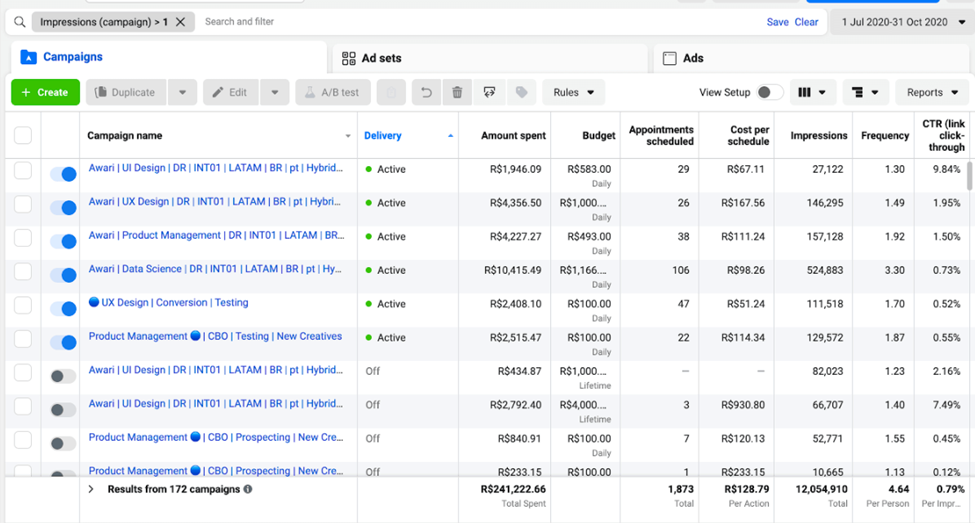

Metric | Result |
Revenue Growth | +300% increase in 3 months |
Business Scale | 3x overall business size in one quarter |
Tracking Accuracy | Complete pixel reconfiguration, all conversion events verified |
Creative Performance | Hypothesis-driven testing pipeline producing weekly winners |
Campaign Stability | Sustained scaling without CPA spikes for the first time in company history |
Results Narrative
Tracking accuracy shifted first. Within the opening two weeks, the pixel reconfiguration meant Facebook’s algorithm was finally receiving complete conversion data for the “Schedule Appointment” event. On its own, this changed the trajectory of every campaign in the account because the algorithm could now optimise for users who converted rather than working off a partial subset of the data.
The inflection point arrived in week four. The restructured campaign funnel and the first batch of new creatives produced through Orange Trail’s creative production service began delivering results at the same time.
Cost per scheduled appointment dropped within the first seven days of the new structure going live, and as the team introduced winning creatives from the testing pipeline into scaling campaigns over the following weeks, CPA continued to decrease while total appointment volume increased. That combination, lower costs and higher volume at the same time, had been impossible under the previous account setup.
By the end of month three, Awari had tripled their revenue. The business had scaled to three times its pre-engagement size, entirely through a single paid channel. For the first time in the company’s history, the team could increase budget with confidence that performance would hold rather than bracing for the CPA spike that had followed every previous scaling attempt.
The growth was not concentrated in one campaign or one audience segment. It was distributed across the full three-tier funnel, which meant it was not dependent on a single variable holding up.
Context
Most edtech brands running Facebook Ads in the Brazilian market see 10% to 20% quarter-on-quarter improvement when optimising aggressively. Awari achieved a 300% revenue increase in one quarter. Against their own history, this was the first time the brand had scaled ad spend without a corresponding collapse in unit economics.
Honest Caveat
Awari‘s pre-engagement baseline was suppressed by the structural problems in the account: broken pixel tracking, no funnel segmentation, stale creatives. The 300% figure is dramatic partly because the starting point was well below what the brand was capable of with a functioning acquisition system.
Single-channel dependency on Facebook Ads also remains a strategic risk that the team continues to address through diversification planning. Sustained growth at this rate requires ongoing creative production, continuous testing, and active audience development. These results are the product of an ongoing system, not a one-time fix.
“They have performed exceptionally well in assisting us with scaling our operations. Our revenue has surged by a remarkable 300%. I wholeheartedly recommend their services.” Awari, Fabio, CEO
Want 300% revenue growth for your education business?
Awari tripled their revenue in three months. If you run an online academy, bootcamp, or education platform and Facebook Ads is your primary acquisition channel, Orange Trail’s performance marketing team can tailor the same approach to your market and programme type.
Are you one of our next success stories?
Book a discovery call
General Industry FAQs
How can an online education or tech school use Facebook Ads to increase enrolments for premium courses and programmes?
A three-tier funnel separating prospecting, engagement retargeting, and conversion retargeting into distinct campaigns with independent budgets and creative sets. Top-of-funnel campaigns introduce the programme to cold audiences using student success stories and career outcome messaging. Mid-funnel retargeting re-engages video viewers and website visitors with social proof. Bottom-funnel campaigns target appointment page visitors and partial form completions with urgency-based offers. Orange Trail’s performance marketing service builds this architecture for edtech clients.
What Facebook targeting and creatives work best for a bootcamp or training academy selling high-ticket courses?
Interest-based targeting combined with lookalike audiences built from past enrolled students delivers the strongest results. Authentic student testimonial videos consistently outperform polished brand content, and the hooks that convert best focus on career transformation outcomes (salary increase, role change, skill acquisition) rather than programme features. Carousel ads showcasing student before-and-after career stories also perform well. Orange Trail’s creative team tests multiple creative angles systematically for education brands.
How should an edtech company structure Facebook campaigns to drive qualified leads that actually convert into paid students?
Optimise for downstream conversion events rather than upstream vanity metrics. Many edtech companies optimise for link clicks or landing page views because those events generate more data volume, but this attracts low-intent users who never enrol. Instead, optimise for the event closest to payment (appointment confirmation, application submission, or purchase) and consolidate ad sets to feed sufficient data into fewer optimisation targets. Fewer leads, but leads that convert at a much higher rate.
How can a career-focused online school use Facebook lead ads and funnels to fill its webinars and info sessions with prospects who buy?
A two-stage funnel. Stage one uses video view campaigns to build a warm audience of users who have watched at least 50% of a programme overview video. Stage two retargets those video viewers with lead ads offering webinar registration.
Because the audience has already demonstrated interest through video engagement, attendance rates and conversion rates run significantly higher than cold traffic campaigns. Post-webinar, a dedicated retargeting sequence addressing common objections drives enrollment.
Which Facebook ad formats are most effective for promoting professional upskilling or career change programmes?
Short-form video (15 to 30 seconds) featuring real student testimonials delivers the strongest overall performance. Carousel ads work well for showcasing multiple career outcomes or programme options in a single unit. For retargeting, single-image ads with direct, benefit-focused copy and a clear call to action convert at the highest rate. Collection ads can work for brands with multiple programme offerings, letting prospects browse options within the Facebook environment.
How can a digital academy use Facebook retargeting to convert website visitors into course enrolments?
Segment retargeting audiences by engagement depth. Users who visited the programme page but did not start the application should see social proof content (testimonials, outcome statistics, employer logos). Users who started but did not complete the application should see reminder ads addressing friction points (time commitment, payment flexibility, career support). Users who completed the application but did not enrol should see urgency messaging (cohort start dates, limited seats, early-bird pricing). Each segment needs its own creative set.
What Facebook Ads messaging resonates best with professionals considering online courses to upgrade their careers?
Messaging focused on career outcomes rather than programme features. “In 6 months, you could be working as a [job title]” outperforms “Learn [skill] in our 6-month programme.” Pain-point messaging acknowledging career stagnation or the fear of falling behind also converts well. Social proof from students who made successful career transitions provides the credibility needed to justify high-ticket decisions. Speak to the transformation, not the curriculum.
How can an education brand optimise Facebook Ads to reduce cost per enrolment while keeping lead quality high?
Three levers: tracking accuracy, creative refresh velocity, and funnel segmentation. First, ensure your pixel correctly tracks the conversion event closest to revenue (enrolment or payment, not just lead submission). Second, maintain a creative testing pipeline producing at least three to four new variants per week, because creative fatigue is the fastest way to see CPAs climb. Third, separate prospecting and retargeting into distinct campaigns so budget is allocated intentionally.
What is the ideal Facebook Ads funnel for selling cohort-based or mentor-led online programmes?
Three stages. Prospecting introduces the programme to cold audiences using aspirational content and career outcome messaging. Consideration retargets engaged users with detailed programme information, mentor introductions, and student testimonials.
Conversion targets high-intent users (appointment schedulers, application starters, webinar attendees) with direct enrolment messaging, often paired with a time-limited incentive aligned to the cohort start date. Each stage should have independent budget control. Orange Trail built this structure for Awari through its performance marketing programme.
How should an edtech startup track and analyse Facebook Ads performance to prove ROI on student acquisition?
Implement the Meta Conversions API alongside the standard pixel for complete data capture despite browser privacy restrictions. Track the full funnel from ad click to enrolment to payment. Calculate cost per enrolment (not cost per lead) as your primary metric and compare against student lifetime value for true ROI.
Use UTM parameters and Google Analytics to cross-reference Facebook-reported conversions against actual site behaviour. Report monthly on blended metrics, but make optimisation decisions based on 7 to 14 day rolling averages.
Awari Specific FAQs
What is the Awari Facebook Ads case study about?
The Awari case study documents how Orange Trail helped a Brazilian online education company achieve 300% revenue growth and triple their business size within three months through a comprehensive Facebook Ads restructure. It covers the tracking, campaign architecture, and creative strategy challenges that prevented profitable scaling, and the systematic approach used to resolve them.
How did Awari use Facebook Ads to grow their business?
Awari used Facebook Ads as their sole paid acquisition channel but could not scale profitably until Orange Trail rebuilt the entire advertising infrastructure. The work involved fixing pixel tracking for the core “Schedule Appointment” event, restructuring campaigns into a three-tier funnel, and implementing a hypothesis-driven creative testing pipeline through Orange Trail’s performance marketing framework.
What results did Awari achieve from their Facebook advertising campaign?
Awari achieved a 300% increase in revenue within three months, tripling their overall business size. The results included stable scaling for the first time in the company’s history, with consistent CPA performance even as ad spend increased substantially.
What Facebook Ads strategy did Awari follow for conversions?
Three pillars: fixing the tracking foundation so the algorithm received accurate conversion signals, restructuring campaigns to separate funnel stages with independent budget control, and building a systematic creative testing process that produced weekly winners. A critical decision was to optimise for confirmed appointments rather than the higher-volume upstream click event.
How did Awari target the right audience on Facebook?
The targeting strategy evolved throughout the engagement. Initial prospecting used interest-based audiences aligned to career development, technology skills, and professional education. As the pixel accumulated accurate conversion data, the team built lookalike audiences from confirmed appointees and enrolled students. Retargeting audiences were segmented by engagement depth, with each segment receiving tailored messaging.
What type of ad creatives did Awari use in their Facebook campaigns?
The highest-performing creatives were authentic student testimonial videos, particularly a short-form video featuring a former student describing their career transition into data science. The testing framework also produced results with static images using career outcome headlines, carousel ads showcasing multiple programmes, and screen-recording walkthroughs of the learning platform. All creatives were produced through Orange Trail’s creative production service.
How much did Awari spend on Facebook Ads and what was their ROI?
Specific budget figures have not been disclosed. Previous attempts to increase daily spend by more than 20% to 25% had consistently resulted in unsustainable CPA increases. Under the new strategy, Awari scaled spend while maintaining stable unit economics for the first time, delivering a 300% revenue increase.
What Facebook ad objectives did Awari use to drive sales?
Campaigns used the Conversions objective, optimising for the “Schedule Appointment” event rather than broader objectives like Traffic or Engagement. This trained Facebook’s algorithm to find users likely to book and enrol rather than users who simply clicked. The team maintained this downstream optimisation despite the smaller data volume, compensating through ad set consolidation and expanded conversion windows.
How can brands replicate Awari's Facebook Ads success?
Audit your pixel and conversion tracking before making any campaign changes. Restructure campaigns to separate prospecting and retargeting with independent budgets. Implement a systematic creative testing pipeline with clear hypotheses, and scale budget incrementally with strict CPA thresholds. Orange Trail’s performance marketing service implements this framework for education and service businesses.
What lessons can marketers learn from the Awari Facebook Ads case study?
Tracking accuracy is the foundation that determines whether everything else works or fails. Campaign structure matters more than individual creative quality, because even strong ads underperform in a poorly architected account. Optimising for downstream events (appointments, enrolments) rather than upstream metrics (clicks, engagement) produces better long-term results despite smaller data volumes. Brands serious about this approach can explore Orange Trail’s performance marketing and agency ad accounts services.